
TTN Research Alert: Iran’s oil cannot be switched off like a refinery unit; The real constraint is not that Iran’s wells would instantly drown if valves were closed; it is that Iran’s oil system is an aging pressure machine whose geology, completions, injection schemes, export terminal, storage buffers and sanctions workarounds all have to remain synchronized
Friday, April 24, 2026 4:46:43 AMEST
- The mistake is to imagine Iran’s oil system as a sequence of tanks behind a pipe. It is closer to a closed-loop pressure organism: Kharg, gathering lines, hidden condensate storage, VLCC floating storage, separators, desalters, produced-water plants, injectors, old wells and fractured carbonate reservoirs all talk to one another through pressure, chemistry and time. Kharg may indeed be the visible throat: if exports stop while field inflows continue, its working storage can fill in days. But Kharg is only the first alarm bell. Iran can stretch the clock with inland tanks, refinery runs, condensate containment and old VLCCs acting as offshore tankage. That makes a crude “10–15 days and everything shuts” too neat. A more serious estimate is that Kharg stress begins in days, systemwide forced curtailment risk becomes acute over several weeks, and something like 20–30 days is a plausible crisis window if the blockade is tight. The question is not when Iran runs out of theoretical storage; it is when it runs out of usable, segregated, safe, exportable and operationally compatible storage.
- The satellite balance sheet is also misleading because outsiders mostly count what moves visibly. Floating-roof tanks betray their inventory by roof height; fixed-roof, concrete, pressure-managed, buried, refinery-adjacent and condensate systems do not. Light condensate is not ordinary crude. It is volatile, high-vapor-pressure and composition-sensitive; store it badly and the light ends evaporate, vapor handling becomes hazardous, product quality changes and blending value is lost. So Iran may possess more hidden short-term capacity than a Kharg roof-count implies. But the reverse is also true: not all nominal capacity is usable. Tanks have bottoms, dead stock, vapor-pressure restrictions, crude-grade segregation rules, H₂S constraints, fire-safety margins, line-fill limitations and export-spec requirements. Storage is not an empty box; it is a process condition. When those conditions fail, barrels may physically exist but become hard to move, blend or certify.
- The floating-storage buffer is equally double-edged. Iran’s shadow fleet is not merely a sanctions-evasion network; it is a distributed offshore tank farm. Old VLCCs can absorb millions of barrels and push the forced-shut-in date outward. But a VLCC used as storage is a decaying piece of process equipment, not a neutral warehouse. It needs inert gas, power, crew, anchorage, inspection, ballast control, ship-to-ship transfer gear, documentation laundering and a buyer willing to accept legal and quality risk. Leave crude or condensate sitting long enough and the cargo itself becomes an engineering problem: stratification, sediment, water bottoms, vapor pressure, contamination, H₂S, wax, asphaltene instability and blending uncertainty. Floating storage therefore buys time by consuming maritime optionality. It delays the reservoir crisis while making the logistics crisis more brittle.
The underground issue is not that shut-in magically “creates water coning.” That is the amateur version. Water coning is normally a production-rate disease: a well pulls too hard, viscous drawdown overcomes gravity, and bottom water rises toward perforations; in horizontal wells, cresting develops along the lateral. A single well shut-in may let a local cone relax. The real danger is fieldwide curtailment in a mature, fractured carbonate province. Iran’s big Zagros reservoirs — Asmari, Bangestan and related systems — are not homogeneous sandstones. They are dual-porosity machines: fractures are the highways, matrix blocks are the warehouses. Pressure disturbances and water can move rapidly through fractures while oil remains trapped inside lower-permeability matrix. Change the boundary conditions abruptly and the reservoir does not pause; it redistributes.
- That redistribution is where the damage hides. Mature fields are managed by a fragile choreography of drawdown, injection, artificial lift, choke settings, zonal isolation, aquifer support and gas/oil/water contact control. If exports are blocked, NIOC cannot simply cut every well by the same percentage. Some wells sit near water contacts, some are watered out, some support blend quality, some are tied to gas handling, some depend on injection patterns, and some should never be restarted aggressively. If water injection continues while production falls, pressure can push water through thief fractures into the wrong compartments. If injection is stopped too abruptly, pressure drops, gas comes out of solution, relative permeability shifts, fines move, scale precipitates and productivity index can fall. The reservoir is damaged not by silence but by uncoordinated pressure commands.
- The most important failure mode is fracture-first sweep. In a clean textbook waterflood, water advances like a front. In a fractured carbonate, water may sprint through connected fractures, faults and vugs, reach a producer, and announce “breakthrough” before the matrix oil has been meaningfully displaced. The well then produces water not because the field is empty, but because the plumbing has found the well. Oil remains behind as capillary-bound, oil-wet or mixed-wet matrix saturation. That is economic damage masquerading as geology. The hydrocarbons are still there, but recovery now requires selective shutoff, gels, cement squeezes, sidetracks, surfactants, polymer systems, revised injection patterns, pressure diagnostics and patience. Under sanctions, those are not routine interventions; they are scarce campaigns.
- Old wellbores make the system still more treacherous. Many mature Middle Eastern carbonate wells penetrate stacked pays with different pressures, saturations and permeabilities. Shut the surface valve and the well does not necessarily become idle; it can become an underground manifold. Water-bearing layers can crossflow into oil-bearing layers. Gas can invade depleted streaks. Sour fluids can migrate behind pipe. Imperfect cement, old completions, corrosion, scale and commingled intervals can turn a shut-in producer into a hidden conduit. The surface gauge may show calm while the reservoir is being rewired. On restart, the operator discovers the new plumbing in the worst possible way: water slugs, H₂S, sand or scale, unstable flow, failed ESPs, tubing corrosion, higher water cut and a well that now needs logging, isolation and workover before it can be trusted.
- The overlooked bottleneck is surface separation. Oil production is actually the continuous industrial separation of oil, gas, water, salts, solids, CO₂, H₂S, emulsions, corrosion products and injected chemicals. A forced curtailment followed by chaotic restart can send separators fluids they were not tuned to handle: tighter emulsions, larger water slugs, more sour gas, higher salt, more scale-forming brine, more oil-in-water and less predictable condensate. Desalters overload. Heater-treaters foul. Produced-water systems breach oil-in-water limits. Reinjection water quality worsens and can plug formations. This is where the drinking-water analogy becomes technically powerful: oilfield produced-water treatment increasingly leans on membrane families familiar from desalination — ultrafiltration, nanofiltration, reverse osmosis, ceramic membranes, polymer membranes and anti-fouling pre-treatment. Bad feedwater kills membranes; bad restart fluids do the same. China is not the only country that can make these systems, but under sanctions it is the only plausible large-scale supplier with the financing, ambiguity and industrial depth to matter. That makes Iran’s true vulnerability systemic: blockade pressure fills tanks, consumes VLCC storage, distorts condensate handling, breaks production-injection balance, worsens water cut, overloads separation, fouls membranes and converts clean barrels into difficult barrels. At the valve, a shut-in is reversible; in the fracture network, wellbore and separation plant, it may not be.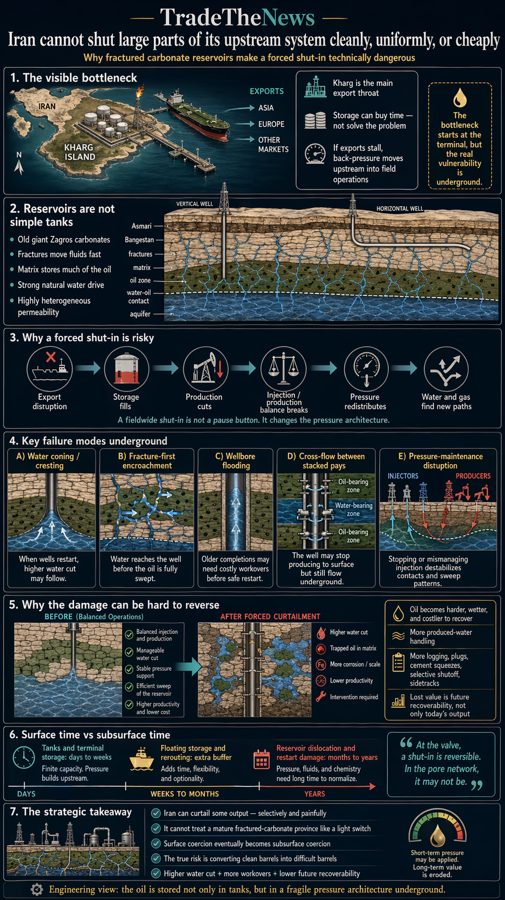
~
- The satellite balance sheet is also misleading because outsiders mostly count what moves visibly. Floating-roof tanks betray their inventory by roof height; fixed-roof, concrete, pressure-managed, buried, refinery-adjacent and condensate systems do not. Light condensate is not ordinary crude. It is volatile, high-vapor-pressure and composition-sensitive; store it badly and the light ends evaporate, vapor handling becomes hazardous, product quality changes and blending value is lost. So Iran may possess more hidden short-term capacity than a Kharg roof-count implies. But the reverse is also true: not all nominal capacity is usable. Tanks have bottoms, dead stock, vapor-pressure restrictions, crude-grade segregation rules, H₂S constraints, fire-safety margins, line-fill limitations and export-spec requirements. Storage is not an empty box; it is a process condition. When those conditions fail, barrels may physically exist but become hard to move, blend or certify.
- The floating-storage buffer is equally double-edged. Iran’s shadow fleet is not merely a sanctions-evasion network; it is a distributed offshore tank farm. Old VLCCs can absorb millions of barrels and push the forced-shut-in date outward. But a VLCC used as storage is a decaying piece of process equipment, not a neutral warehouse. It needs inert gas, power, crew, anchorage, inspection, ballast control, ship-to-ship transfer gear, documentation laundering and a buyer willing to accept legal and quality risk. Leave crude or condensate sitting long enough and the cargo itself becomes an engineering problem: stratification, sediment, water bottoms, vapor pressure, contamination, H₂S, wax, asphaltene instability and blending uncertainty. Floating storage therefore buys time by consuming maritime optionality. It delays the reservoir crisis while making the logistics crisis more brittle.
The underground issue is not that shut-in magically “creates water coning.” That is the amateur version. Water coning is normally a production-rate disease: a well pulls too hard, viscous drawdown overcomes gravity, and bottom water rises toward perforations; in horizontal wells, cresting develops along the lateral. A single well shut-in may let a local cone relax. The real danger is fieldwide curtailment in a mature, fractured carbonate province. Iran’s big Zagros reservoirs — Asmari, Bangestan and related systems — are not homogeneous sandstones. They are dual-porosity machines: fractures are the highways, matrix blocks are the warehouses. Pressure disturbances and water can move rapidly through fractures while oil remains trapped inside lower-permeability matrix. Change the boundary conditions abruptly and the reservoir does not pause; it redistributes.
- That redistribution is where the damage hides. Mature fields are managed by a fragile choreography of drawdown, injection, artificial lift, choke settings, zonal isolation, aquifer support and gas/oil/water contact control. If exports are blocked, NIOC cannot simply cut every well by the same percentage. Some wells sit near water contacts, some are watered out, some support blend quality, some are tied to gas handling, some depend on injection patterns, and some should never be restarted aggressively. If water injection continues while production falls, pressure can push water through thief fractures into the wrong compartments. If injection is stopped too abruptly, pressure drops, gas comes out of solution, relative permeability shifts, fines move, scale precipitates and productivity index can fall. The reservoir is damaged not by silence but by uncoordinated pressure commands.
- The most important failure mode is fracture-first sweep. In a clean textbook waterflood, water advances like a front. In a fractured carbonate, water may sprint through connected fractures, faults and vugs, reach a producer, and announce “breakthrough” before the matrix oil has been meaningfully displaced. The well then produces water not because the field is empty, but because the plumbing has found the well. Oil remains behind as capillary-bound, oil-wet or mixed-wet matrix saturation. That is economic damage masquerading as geology. The hydrocarbons are still there, but recovery now requires selective shutoff, gels, cement squeezes, sidetracks, surfactants, polymer systems, revised injection patterns, pressure diagnostics and patience. Under sanctions, those are not routine interventions; they are scarce campaigns.
- Old wellbores make the system still more treacherous. Many mature Middle Eastern carbonate wells penetrate stacked pays with different pressures, saturations and permeabilities. Shut the surface valve and the well does not necessarily become idle; it can become an underground manifold. Water-bearing layers can crossflow into oil-bearing layers. Gas can invade depleted streaks. Sour fluids can migrate behind pipe. Imperfect cement, old completions, corrosion, scale and commingled intervals can turn a shut-in producer into a hidden conduit. The surface gauge may show calm while the reservoir is being rewired. On restart, the operator discovers the new plumbing in the worst possible way: water slugs, H₂S, sand or scale, unstable flow, failed ESPs, tubing corrosion, higher water cut and a well that now needs logging, isolation and workover before it can be trusted.
- The overlooked bottleneck is surface separation. Oil production is actually the continuous industrial separation of oil, gas, water, salts, solids, CO₂, H₂S, emulsions, corrosion products and injected chemicals. A forced curtailment followed by chaotic restart can send separators fluids they were not tuned to handle: tighter emulsions, larger water slugs, more sour gas, higher salt, more scale-forming brine, more oil-in-water and less predictable condensate. Desalters overload. Heater-treaters foul. Produced-water systems breach oil-in-water limits. Reinjection water quality worsens and can plug formations. This is where the drinking-water analogy becomes technically powerful: oilfield produced-water treatment increasingly leans on membrane families familiar from desalination — ultrafiltration, nanofiltration, reverse osmosis, ceramic membranes, polymer membranes and anti-fouling pre-treatment. Bad feedwater kills membranes; bad restart fluids do the same. China is not the only country that can make these systems, but under sanctions it is the only plausible large-scale supplier with the financing, ambiguity and industrial depth to matter. That makes Iran’s true vulnerability systemic: blockade pressure fills tanks, consumes VLCC storage, distorts condensate handling, breaks production-injection balance, worsens water cut, overloads separation, fouls membranes and converts clean barrels into difficult barrels. At the valve, a shut-in is reversible; in the fracture network, wellbore and separation plant, it may not be.